Valorant Champions Shanghai, What Day 7 of the Group Stage Revealed
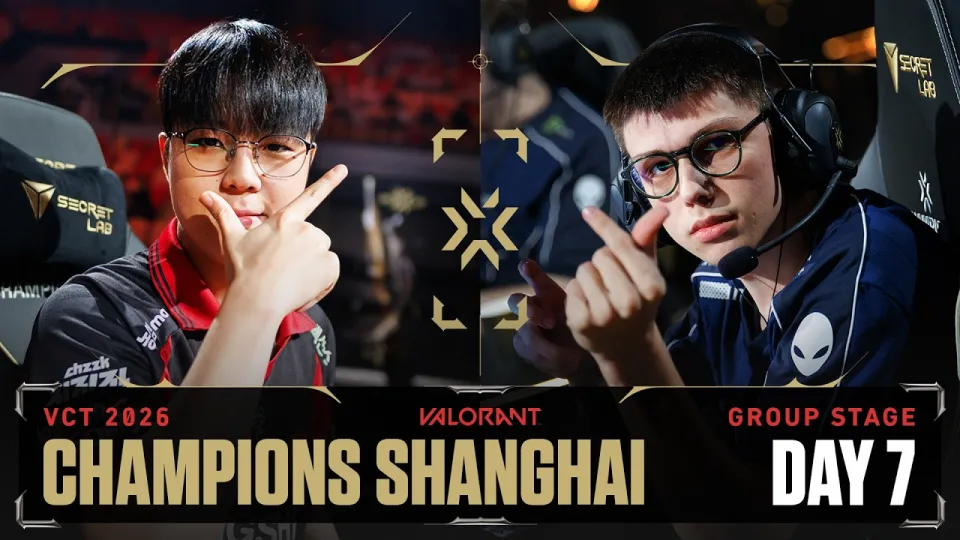
Video: VALORANT Champions Shanghai — Group Stage — Day 7
Want articles like this for your own video to promote it on YouTube and Google? Order them through the Telegram bot @sat_sit_bot. Articles with your video embedded are written and posted by the bot itself — on popular topical sites (no ads). Free trial — 50 articles.
· based on the channel VALORANT Champions Tour
Key takeaways
- Valorant Champions Shanghai runs September 24 to October 18 and crowns the 2026 world champion.
- Sixteen teams from Americas, CN, EMEA and Pacific compete in the group stage.
- Two different Masters titles changed hands in 2026 before Shanghai, reshaping expectations.
- Day 7 of the group stage was repeatedly interrupted by technical pauses, a recurring theme in viewer comments.
- Group stage matches are best-of-three; playoffs move to a best-of-five format.
Valorant Champions Shanghai is the final VCT event of the 2026 season, where sixteen teams from Americas, CN, EMEA and Pacific fight for the world title between September 24 and October 18. Day 7 of the group stage, broadcast by the VALORANT Champions Tour, sits at the point where group standings start to harden and every map swing changes who advances. For live scores, bracket updates and announcements straight from the event, follow the official VALORANT Esports account on X.
What the Valorant Champions Shanghai format actually demands
The Shanghai group stage is a best-of-three gauntlet in which sixteen qualified teams are split into groups, and only the top finishers move on to the playoff bracket. Because the season already produced two different Masters champions in 2026, the seeding in Shanghai matters more than usual: regional first seeds get softer opening opponents, while second and third seeds from stacked regions can land in a group where one bad pistol round decides the entire run.
A few structural points shape how Day 7 should be read:
- Group stage matches are best-of-three, so map veto and the first map's pistol round carry outsized weight.
- Playoffs switch to best-of-five, which rewards teams with deep map pools rather than one comfort pick.
- Sixteen teams across four regions means cross-regional results are the only reliable form guide.
- Tiebreakers inside groups are decided by head-to-head and round differential, so a 13-11 loss is not the same as a 13-3 loss.
That last point is why Day 7 results feel so consequential. A team that drops a close series but keeps round differential healthy can still control its own fate; a team that gets blown out on one map hands its rivals a tiebreaker advantage it cannot recover.
Why the Day 7 broadcast kept stopping
The most visible story of Day 7 was not a clutch or a comeback but the number of technical pauses that interrupted the server. Viewers flagged the repeated stoppages almost immediately, and the pattern became the running joke of the chat long before the final map was decided.
Technical pauses in a studio setting usually trace back to a short list of causes:
- a player's peripheral or PC dropping connection mid-round;
- server-side instability requiring a round restore;
- a coach or observer feed issue that forces the production team to reset;
- anti-cheat or tournament client checks triggered by a hardware swap.
For competitive integrity, officials restore the round state rather than replay it, which is why a pause can stretch for minutes while the exact economy, ultimate points and player positions are rebuilt. That process is slow but necessary: replaying a round from scratch would hand one team information it did not earn. The practical cost is rhythm. Teams that build momentum through fast-paced retakes lose it during a ten-minute stoppage, and the broadcast's own talent has to fill air while the server is frozen.
The CN question: results versus expectations
The harshest debate around Day 7 concerned the Chinese representatives, and it followed a familiar shape: strong domestic form, shaky international conversion. Commentators and viewers pointed at lost eco rounds, failed 5v2 retakes and utility usage that looked reactive once scripted setups broke down.
Those criticisms deserve context rather than dismissal. CN teams in 2026 have improved mechanically to the point where individual duels are no longer the gap; the gap shows up in adaptation. When a set execute fails, the best international teams pivot into a default, trade-heavy mid-round style within seconds. A team that has drilled only the execute tends to stall, burn utility late and lose the post-plant to a simple flank.
The counterargument from the other side of the bracket is equally valid: several strong teams outside CN did not qualify for Shanghai at all, so judging the region purely on its worst group-stage maps is unfair. What Day 7 did establish is that CN's ceiling is real and its floor is still lower than the top EMEA and Pacific sides.
Reading the group stage like a coach
Day 7 is useful precisely because it exposes patterns that a single highlight reel hides. If you want to extract real insight from a group-stage broadcast, watch for these signals rather than the scoreline:
- Pistol conversion rate. Teams that win pistols and convert the following bonus round control the economy for four rounds.
- Retake discipline. Watch whether defenders save utility for the retake or waste it on the initial hold.
- Ultimate economy. A duelist ultimate held for a lost round is value burned; the best teams force it early.
- Post-plant positioning. Crossfires set before the spike is planted beat crossfires improvised after.
- Timeout timing. A timeout taken after two lost rounds is a coach reading the game; a timeout taken after four is a coach reacting to it.
Applied to Shanghai, those five markers explain most of the upsets in the group stage. The teams that advanced comfortably were rarely the ones with the flashiest aim; they were the ones whose economy never collapsed and whose utility never sat unused.
What to watch before the bracket locks
With the group stage nearing its close, three things decide who reaches the playoff stage in Shanghai. First, map pool depth: a team that can only win on one map is a coin flip in a best-of-three and a guaranteed loss in a best-of-five. Second, comp flexibility: the 2026 meta rewards teams that can swap between double-controller and double-initiator structures without losing their identity. Third, composure under stoppage, which Day 7 tested more than any other day of the event.
Familiar names still carry expectations into the bracket, but the season's two Masters titles already proved that reputation does not survive contact with a well-drilled challenger. The group stage's job is to sort the pretenders from the teams that can actually close a series when the server is stable and the crowd is loud.
Useful links
- Official VALORANT Esports updates on X: https://x.com/valorantesports
- Facebook: https://www.facebook.com/ValorantEsports/
- Instagram: https://www.instagram.com/valorantesports/
- TikTok: https://www.tiktok.com/@valorantesports
- Twitch: https://www.twitch.tv/valorant
The takeaway from Shanghai's group stage
Day 7 of Valorant Champions Shanghai showed a group stage doing exactly what it should: separating teams that adapt from teams that only execute. The technical pauses were frustrating, but they tested composure in a way a clean server never would, and the CN debate exposed a real gap between mechanical skill and mid-round creativity. The bracket that emerges will reward map depth, economy discipline and coaches who call timeouts before the collapse rather than after it. For the full broadcast and every following day of the event, the VALORANT Champions Tour channel is the source, and the official VALORANT Esports X account is where schedule changes and bracket updates land first.
Questions & answers
How many teams play in the Valorant Champions Shanghai group stage?
Sixteen teams qualified from the Americas, CN, EMEA and Pacific regions. They are divided into groups and play best-of-three series, with the top finishers advancing to the playoff bracket. The event runs from September 24 to October 18.
Why were there so many technical pauses during Day 7?
Technical pauses happen when a player's hardware, the tournament server or the production feed fails mid-round. Officials restore the exact round state instead of replaying it, which protects competitive integrity but takes several minutes. Multiple stoppages in one day usually mean more than one separate issue rather than a single recurring fault.
Are CN teams really weaker than other regions at Champions?
The gap is narrower than the criticism suggests. CN players hold their own in individual duels, but their mid-round adaptation lags when scripted executes break down, which shows up in lost eco rounds and failed retakes. It is also fair to note that several strong teams from other regions did not qualify for Shanghai at all.
What is the difference between the group stage and the playoffs in Shanghai?
Group stage matches are best-of-three, so map veto and pistol rounds decide a lot. Playoffs move to best-of-five, which punishes teams with shallow map pools and rewards deep, flexible compositions. That is why group-stage form does not always translate into a deep playoff run.
Source: VALORANT Champions Shanghai — Group Stage — Day 7 · Markdown version